What AI Transformation Actually Is
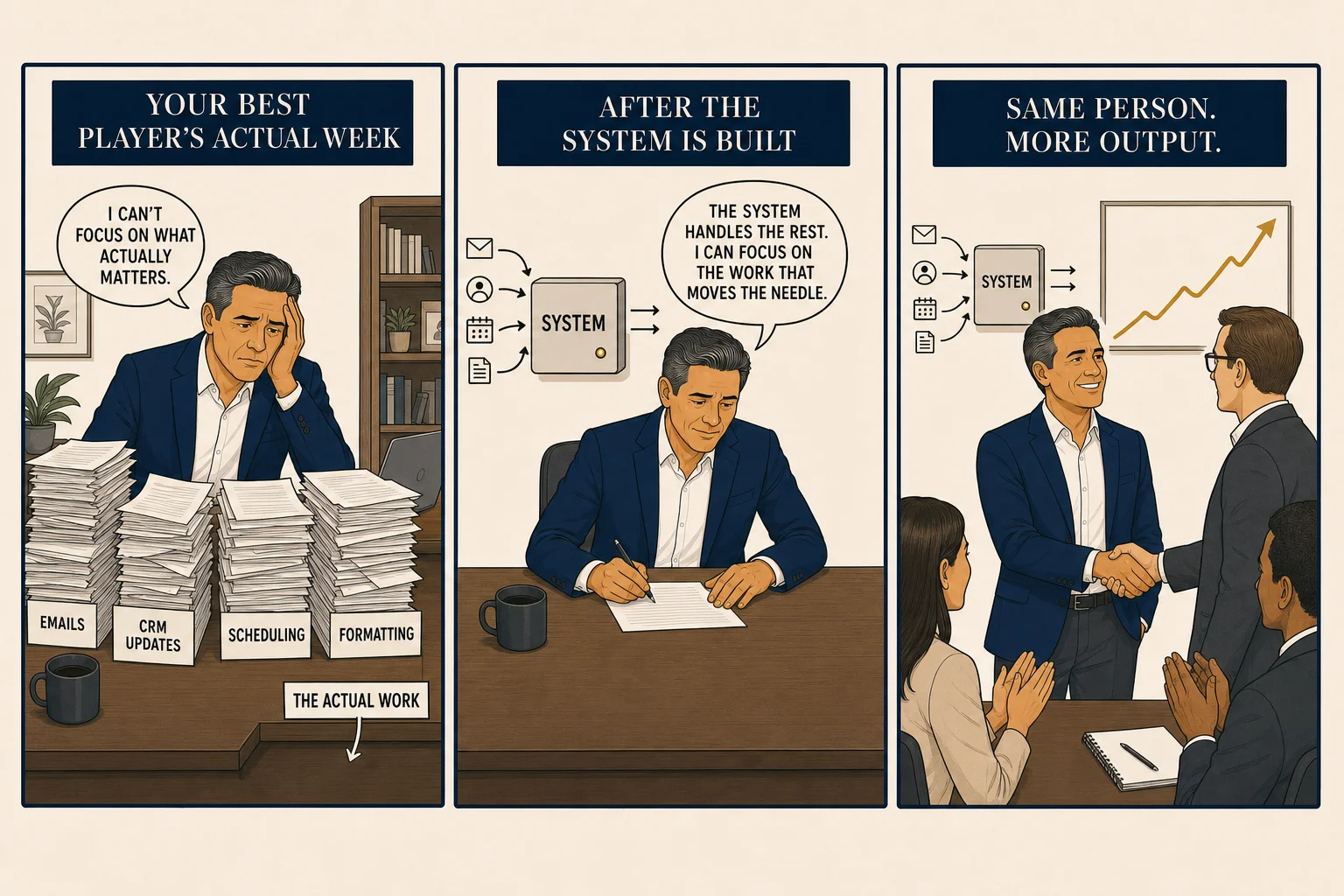
AI transformation is the process of progressively automating your business by weaving reasoning steps into processes that previously required a human — so your best people get freed from the loops they were only in because there was no alternative.
Start with what a business is
A business is a process of delivering a product or service to a specific kind of customer. That process is a sequence of steps. Each step depends on the one before it. The whole chain exists to move a customer from problem to solution.
Before AI, every step that required a judgment call forced a human into the loop. Routing a complaint to the right team. Qualifying whether a lead was worth pursuing. Triaging which support ticket needed attention first. The process stopped and waited for a person because there was no other way to make the reasoning call. That is what made humans load-bearing in those spots — not because humans are better than machines at everything, but because machines could not make the judgment call. So humans had to.
What changed is that reasoning steps can now be woven into automated processes inline. A step that previously halted and waited for a person can now complete with a reasoning system making the call, and the human stays out of that loop. The process keeps moving. That is the specific breakthrough — not AI replacing people broadly, but a new category of automation now available for steps that previously required judgment.
ROI is the only real filter
The default for every change should be the one that provides the highest return. Not the one that sounds most innovative, not the one a vendor is pushing hardest, not the one that looks most impressive in a demo. The one with the clearest, most calculable return.
A business owner pays for two things: what makes more money, and what saves enough time to make more money. Everything else is fluff. Real AI transformation has a return you can calculate before you build it. If a provider cannot tie the work to a number, that is the tell. The agent opportunity analysis is the framework for finding and ranking those numbers across your specific functions.
Where AI is most powerful: the bottleneck
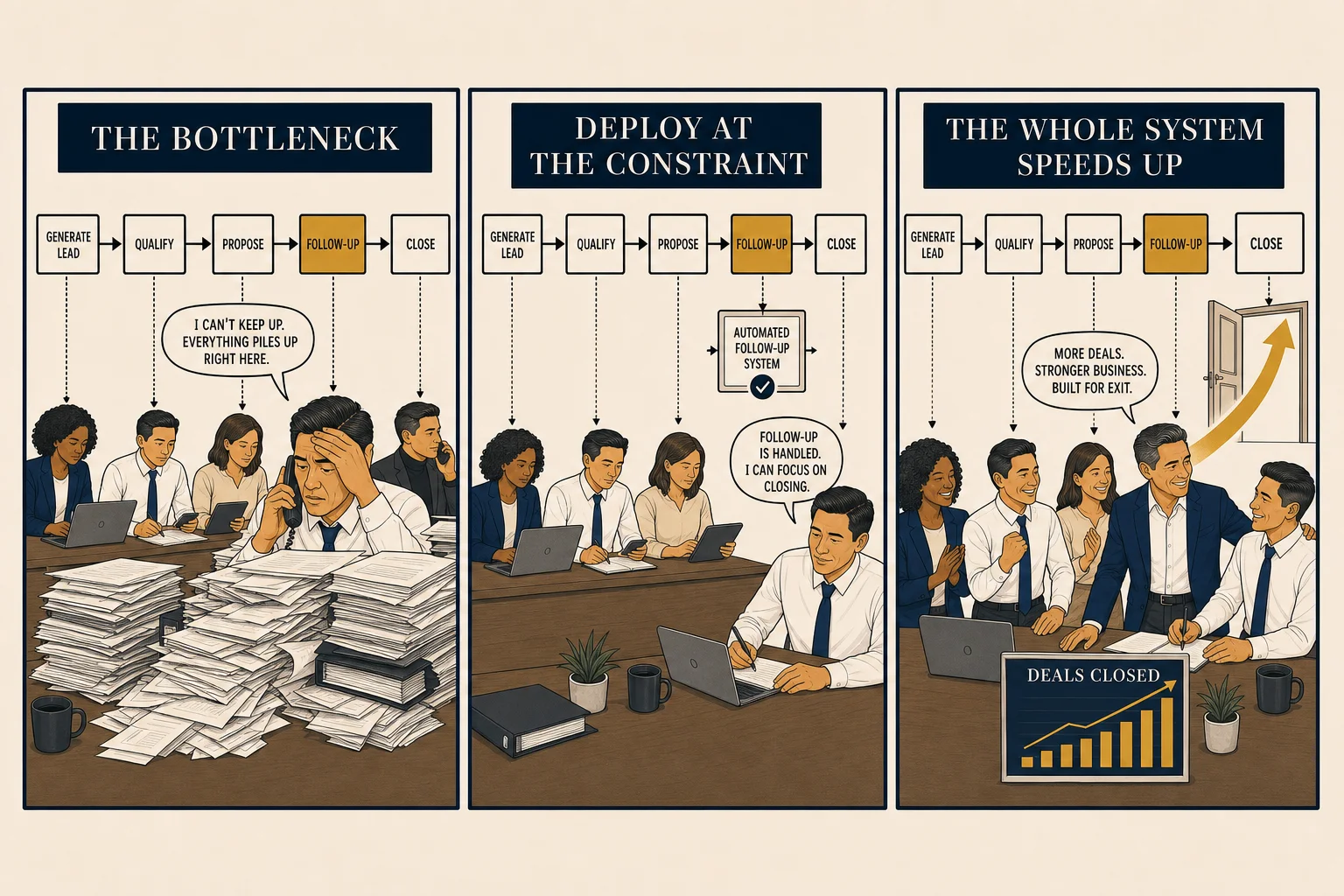
Think of your business as one continuous sequence of discrete steps delivering value to a single customer. Somewhere in that sequence is a bottleneck — the step where capacity is most constrained, where work piles up, where the whole chain slows down.
Eliyahu Goldratt's The Goal — reportedly Jeff Bezos's favorite business book — makes one claim that applies directly here: the throughput of any system is determined by its bottleneck. Every improvement that is not at the bottleneck is an illusion. You can optimize every other step perfectly and move nothing.
AI is exceptionally good at bottleneck diagnosis and removal. An agentic system can analyze where work accumulates, what is causing it, and whether the constraint is a judgment call that can now be automated. When you deploy AI at the bottleneck instead of at a convenient-but-non-critical step, the whole system speeds up. That is what separates transformation that shows up in the numbers from transformation that just produces a good demo.
Proven process first
This is the prerequisite most vendors will not tell you: AI transformation only works on top of functions that already work. Automating a process that has not been manually proven is not transformation. It is accelerating a mistake.
You can only free a human from a loop if you understand why they were in it. That means knowing the SOP — what decision they were making, under what conditions, with what inputs. If you do not have that documented, you cannot hand it to a reasoning system. The documentation is not bureaucracy; it is the specification that makes the handoff possible.
Companies with unproven processes should prove those processes first. Documentation is a solvable problem. Ontology is a solvable problem. A function that has never actually worked is a different problem, and AI is not the answer to it.
What gets freed, and for what
When the repeatable work moves to the system, the people doing it get their hours back. The answer to what happens next depends on the function. A sales team freed from administrative drudgery should take more calls and close more deals. A finance team freed from manual reconciliation should spend more time on analysis. The freed capacity flows toward the work that requires a person: judgment, relationship, creative decision-making. See the seat wrapper for how this gets built at the level of a specific role.
One thing worth saying plainly: this is not a near-term case for labor replacement across existing organizations. The practical use is specific humans, in specific loops, freed from specific judgment calls. That is valuable and it compounds. It is not the same claim as "AI will replace your workforce," and treating it as such leads to bad decisions in both directions.
What it is not
The most common misreading is that AI transformation means replacing people with AI characters — a one-to-one swap of a human with an automated agent. Personifying automation this way is not just inaccurate; it actively gets in the way of understanding what matters: the load-bearing structures of the business, where the constraints are, and what the processes actually require.
Buying tools, bolting a chatbot onto the side of the business, running a one-time project: none of those are transformation. Transformation is an operating change built on a documented source of truth about how the company actually runs.