Why AI Now Sets Your Ceiling
AI has become a variable that shapes what a company is worth, so the bar for a serious operation now sits above clean financials: it is a documented, transferable, AI-augmented operation.
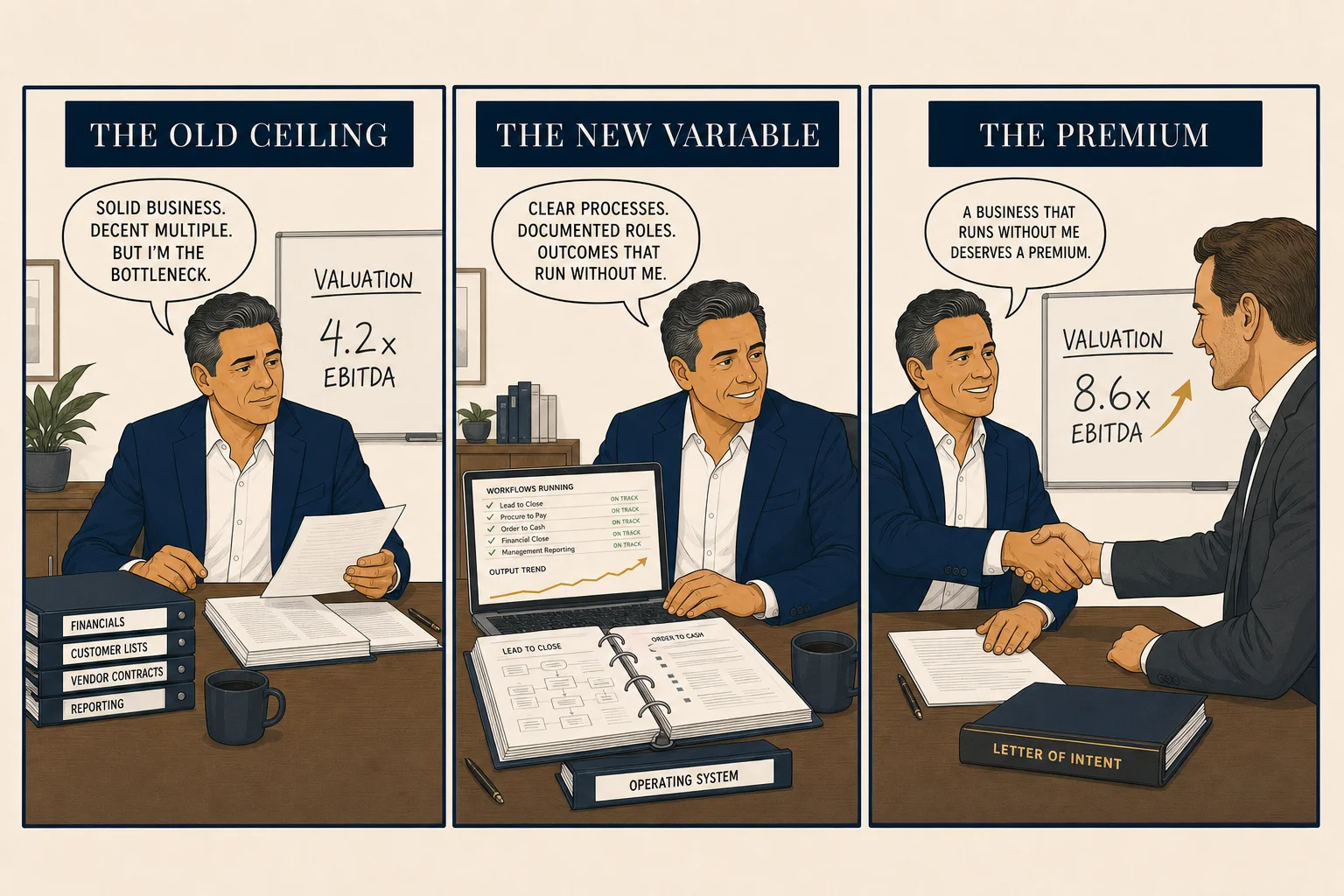
A New Variable in the Value Equation
For decades the math was stable. A company's worth came down to its earnings, the durability of those earnings, and the risk attached to them. AI did not change the structure of that equation. It added a new variable to it, and a heavy one.
That variable is whether your business genuinely runs on AI or merely talks about it. The two are starting to be priced differently. A company that has embedded AI into how it actually operates reads as more scalable, more defensible, and less dependent on adding headcount to grow. A company that has not reads as one about to face rising costs against competitors who move faster and cheaper.
The Premium Is Large and It Is Being Priced In
This is not a soft, someday claim. EisnerAmper's 2025 analysis of private-company valuations found that businesses with genuinely embedded AI command materially higher valuations than otherwise comparable peers without it, on the order of roughly 40 to 100 percent higher.
Sit with that range. At the high end, AI maturity can come close to doubling what a company is worth on the same earnings. The reason is straightforward: AI leverage points directly at lower future cost and faster future scale, which is exactly the kind of story that justifies paying more for the same profit today.
What is really being priced is operational maturity. AI that lives in a slide deck is worth nothing. AI that is wired into how the work gets done, with the gains showing up in the numbers, is worth a premium because it survives the people who built it and keeps running.
Clean Books Were Always the Floor
None of this retires the basics. The business still has to stand on its own and the numbers still have to hold up. But clean books were always the floor, not the ceiling. They get you taken seriously. They do not, by themselves, earn the premium.
What has changed is that the same logic that always applied to owner dependence now extends to AI. A business where the leverage lives only in the owner's head, or in one clever person's manual workflow, is fragile. A business where it is built into the process is durable. The honest goal is the second one.
The Single Commercial Case
Stated plainly and then set aside: done right, AI transformation should produce higher revenue, more operational efficiency, and, should you ever sell, a higher multiple. That is the whole commercial case for doing this well. The rest of this wiki is about the harder question underneath it, which is what is actually worth doing in your specific business, covered in There Is No Templated Transformation and Get Clarity Before You Transform.
The window is not open forever. Once embedded AI becomes the expectation rather than the differentiator, the premium for having it fades into a penalty for lacking it. That is the case for being deliberate now rather than reactive later.
Further Reading
- What Is AI Transformation
- The AI Valuation Premium
- Owner Dependence: the structural cap that AI leverage now extends.
- SOPs as an Asset
- AI Now Decides Your Multiple
Sources: EisnerAmper, "How AI Is Shaping the Valuation of Private Companies," 2025; the Built for Exit papers The Writing On the Wall and Supersuit Up or Get Left Behind.