How to Document Your SOPs in the Age of AI
Writing down how your company runs used to be a chore you put off. In the age of AI it is the highest-value thing you can do, because the same document that makes the business transferable is the one your AI needs to be useful.
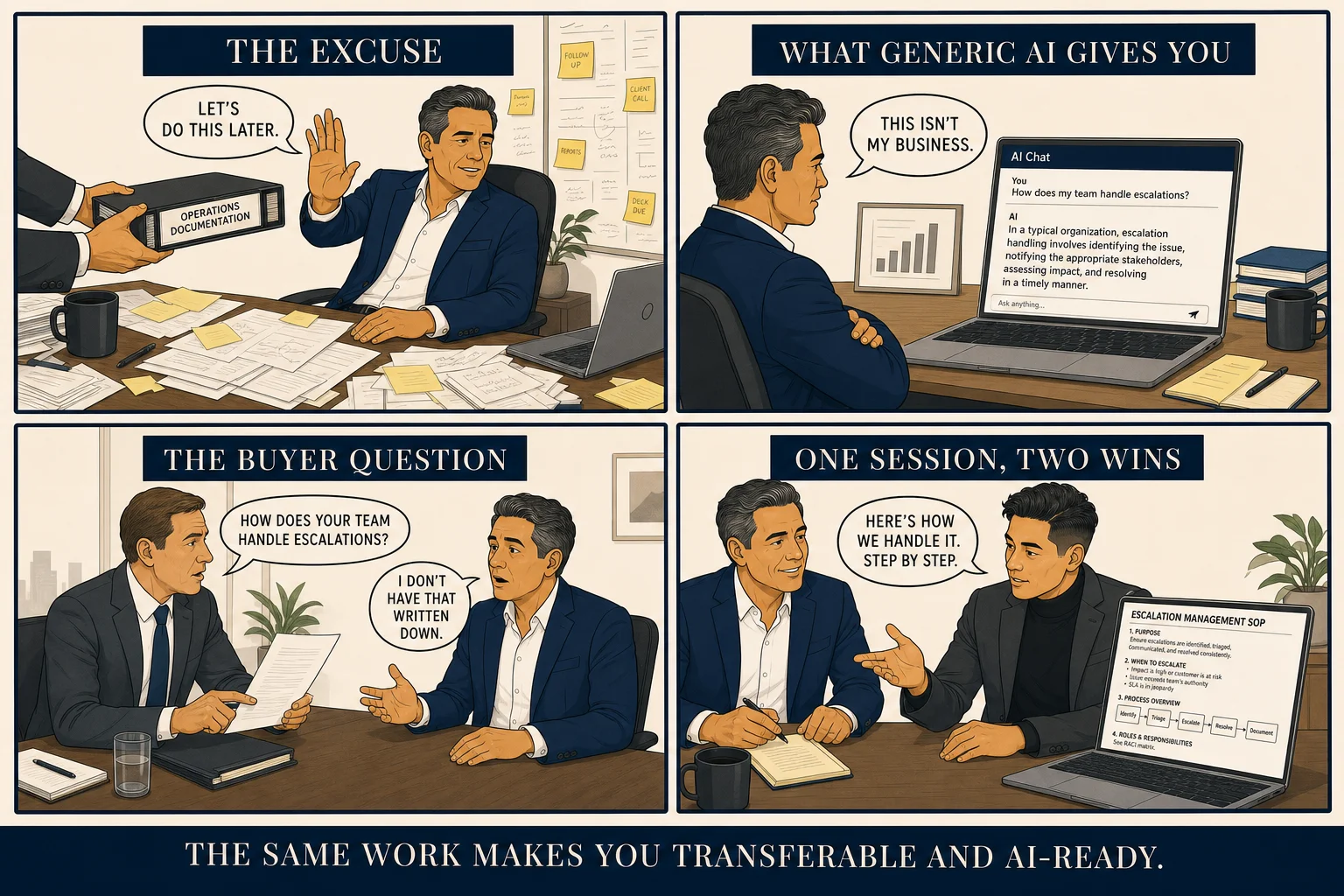
Most owners know they should document their operations and never do, because it feels like homework with no payoff. AI changes that math. The act of getting your company out of people's heads and onto the page now does two jobs at once: it makes the business durable and transferable, and it gives any AI you deploy a true picture of how you actually work. Skip it and your AI produces confident, generic slop; do it and the same tools generate on-brand, company-aware work. This page is the practical method.
Start with seats, not tasks
Do not start by listing tasks. Start by listing seats: the roles that keep the business running, named whether or not a single person fills each one. For a multi-story building that might be general manager, building engineer, leasing, janitorial, security, accounting, tenant relations, and vendors. Seats give you a complete map fast, and they are the unit a new hire, or an AI, actually steps into.
Interview each seat with the same eight questions
For every seat, ask the same short set. Breadth first, depth later.
- What is this seat called, and who sits in it today?
- What is it responsible for? The three to seven things that are clearly its own.
- What does good look like here? How do you know it is being done well? (this is the seed of a scorecard)
- What does it need to know or have access to? Systems, documents, keys, contacts.
- Walk me through a normal week, or what happens when the common event hits. (this is the SOP seed)
- Where does this knowledge live today? In a person's head, in software, or nowhere.
- What frustrates you most about this seat right now?
- If this person vanished tomorrow, what breaks and who scrambles?
Question seven surfaces the real problems and where the return is. Question eight surfaces owner dependence and the fragile single points of failure.
Capture and build in the same sitting
The old way was to interview, then disappear for weeks, then deliver a binder nobody reads. The better way now is a live loop: capture a seat, turn it into a structured page immediately with AI, show the person, let them correct it, move on. The subject watches their knowledge become a documented system in real time. It is faster, the corrections happen while memory is fresh, and it is the most honest demonstration of what AI transformation actually feels like.
Aim for transferability, not completeness
The bar is not a perfect manual. The bar is: could someone new run this seat from what we wrote down? Stub the procedures, capture the whole map, and deepen the few seats that matter most in a second pass. A complete, shallow map beats a deep, half-finished one, because the gaps are visible and rankable.
What you end up with is the start of an Organizational Truth Repo: a living, documented source of truth that makes the company both transferable and ready for AI to act on. The work that gets your business out of your head is the same work that makes your AI worth anything. See also SOPs as an Asset and Documentation Equals Transferability.
Further reading
- The Organizational Truth Repo
- SOPs as an Asset
- Documentation Equals Transferability
- Owner Dependence
- Agent Opportunity Analysis
Source: Built for Exit, "Supersuit Up or Get Left Behind."