How to Choose a Transformation Partner
A flood of AI transformation partners is coming for your business, and choosing well is the difference between a defensible investment and an expensive lesson, so treat the choice with the same rigor you would bring to any major investment.
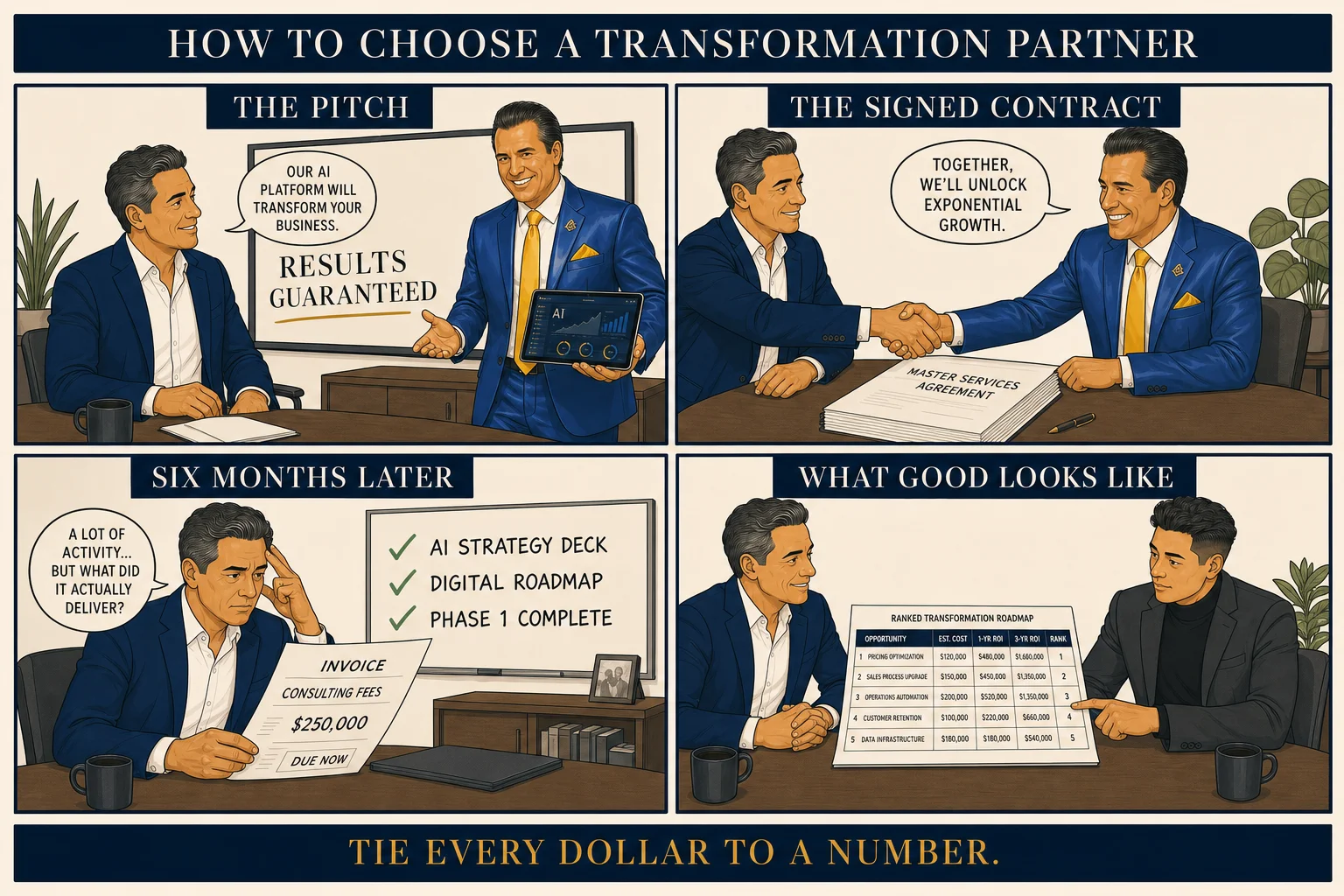
You are about to be sold to. The AI moment has created a gold rush of consultancies, agencies, and freshly rebranded IT shops, all calling themselves transformation partners, all confident they can change your business. Some are excellent. Many are not. A few will take a large check and leave you with demos that never touch your P&L. This page is a buyer's guide for telling them apart, written from your side of the table.
The stakes are high in a way owners underestimate. The wrong partner does not just waste money. They burn the scarce window in which transformation could have lifted your company's value, and they leave you with sunk cost, organizational fatigue, and a story that now reads as a failed experiment. Choosing well is not a procurement task. It is a value-preservation task.
The right partner does not deliver a project and leave. They build the flywheel — the self-reinforcing system where the organization's collective knowledge, data, and processes compound over time into better outputs with less human input. That is what a compounding organization looks like, and it is the only outcome worth paying for.
What Good Looks Like
A genuinely good transformation partner has a few traits that are easy to name and hard to fake.
They start from your economics, not their toolkit. The first thing a good partner wants to understand is where the money is in your business and what would change it, which is the same instinct as a real agent opportunity analysis. A partner who leads with technology before they understand your unit economics is selling a hammer and calling everything a nail.
They tie every proposed initiative to a number. Good partners are comfortable saying "this one is worth roughly this much and here is how we will measure it," and equally comfortable saying "this one is not worth doing." A partner who is allergic to ROI estimates is a partner who does not want to be held to them.
They build for transfer, not dependence. The best partners hand you capability, documented systems, trained people, processes your team owns. They are working to make themselves unnecessary. This matters because capability that lives only in the partner's heads is owner dependence wearing a different costume, and it walks out the door the day they do.
They show you proof from businesses like yours. Not logos. Outcomes, with numbers, ideally in your size range and industry. A partner who serves the Fortune 500 may have nothing useful for a mid-market operator, and vice versa.
They scope tightly and prove early. Good partners want a small, fast, measurable first win before you commit to a big program, because they are confident they can deliver one. They are selling you results, so they are happy to be tested cheaply first.
The Red Flags
The warning signs are just as nameable.
The blank-canvas pitch. If a partner is happy to start a large engagement without you having a ranked, ROI-backed view of what is worth doing, they are happy to bill you while they figure it out. This is exactly why you want clarity before you transform.
Scope that only grows. Watch the shape of the proposal. If every conversation makes the engagement bigger and longer, and never smaller or more focused, you are seeing their incentives, not your needs.
Technology-first theater. Impressive demos, trendy model names, and dashboards that do not connect to a dollar of revenue or a dollar of cost. Ask what changed in the P&L. If the answer is vague, the value is too.
No clear measurement plan. If a partner cannot tell you, before starting, how you will both know whether it worked, they have arranged never to be wrong. That protects them, not you.
Lock-in by design. Proprietary systems only they can maintain, no documentation handed over, key knowledge that lives only with their staff. This is a partner building their own annuity at the expense of your transferability.
Pressure and FOMO. "Everyone is doing this, you are already behind, sign now." Urgency is a sales tactic. The real urgency, the repricing of your company's value, is a reason to choose carefully, not quickly.
The Questions to Ask
Bring these to every partner conversation. The quality of the answers will sort the field fast.
- Which of our economics would you target first, and why that one?
- What is your honest ROI estimate for the first initiative, and how will we measure it together?
- What does your smallest possible first engagement look like, and what would it prove?
- When this is done, what will my team own and operate without you?
- Show me a result, with numbers, from a business close to my size and industry.
- What would you tell me not to do, and why?
- If we parted ways after phase one, what would we keep?
A strong partner answers these comfortably and specifically. A weak one redirects to their methodology, their logos, or the urgency of the moment.
Why Partner-Agnostic Clarity Protects You
The single most powerful move you can make is to walk into these conversations holding your own map. When you already have a ranked, ROI-backed view of what is worth doing, built independently of anyone who will be paid to execute it, the entire dynamic shifts in your favor.
You stop asking "what should I do," which invites the largest possible answer, and start asking "here is what we have determined is worth doing and in what order, can you execute it, and where do you disagree." That is a conversation between an informed buyer and a vendor, not a patient and a specialist. It lets you compare partners on the same scope, hold them to the same numbers, and walk away from any one of them without losing your plan.
The clarity has to be partner-agnostic to do this work. A roadmap drawn by the firm that will be paid to build it is not a roadmap, it is a quote. The protection comes precisely from the independence.
How to Make the Spend Defensible to Your Board
Whether your "board" is an actual board, a co-owner, a spouse, or your own future self in diligence, the spend has to be defensible. Defensibility comes from three things, and a good partner makes all three easy.
First, prioritization on the record: we did this because it ranked first on an independent map, not because it was pitched well. Second, estimates before results: we said it would cost roughly this and be worth roughly that, in writing, before we started. Third, measured outcomes: here is what actually happened against the estimate. That structure converts spend from a gamble into an investment, and it is exactly the discipline that proves you ran transformation like an operator, with proven value rather than described potential.
The owner who can show a ranked plan, pre-committed estimates, and measured results has a real story. The owner who can only show invoices and demos has a liability dressed as an initiative.
The cleanest way to walk into the partner market protected is to bring your own independent, ranked, ROI-backed map. That is what the Agentic Business Blueprint Intensive at builtforexit.ai produces, the blueprint you build your value-maximized company from, and the document that keeps you in control of every partner conversation that follows.
Further reading
- Get Clarity Before You Transform
- There Is No Templated Transformation
- AI Now Decides What You're Worth
- Agent Opportunity Analysis
- The Transformation Flood
Sources: Built for Exit, "The Writing On the Wall"; Built for Exit, "Supersuit Up or Get Left Behind."